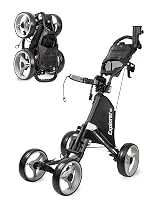
Best Golf Pull Carts: How to Choose
The best golf pull cart for most walkers is a light 2-wheel puller if you want the simplest, most compact option, and a 3-wheel cart if you want a stable push with a hand brake. Your choice comes down to wheels, weight, brake type and folded size.
On this page (9 sections)
- What should you look for in the best golf pull cart?
- Two wheels or three: which cart suits your course?
- How much does cart weight matter on the course?
- Which brake and handle setup do you need?
- How small should the cart fold for your trunk?
- Do storage and extras change the cart you buy?
- How do the three picks compare for real rounds?
- Is a golf pull cart worth it for your game?
- Which golf pull cart should you buy?
The best golf pull cart for most walkers is a light two-wheel puller when you want the simplest, most compact option. A three-wheel cart is the better pick when you want a stable push, a hand brake and more storage for a full round.
The names blur together, since plenty of people say pull cart for either kind. What actually changes your round is wheel count, cart weight, brake type and how small it folds.
Those four points decide whether a cart helps or gets in your way.
This guide walks through each one, names the cart we would buy for common needs and ends with a clear rule for choosing. If you want the wider field first, our guide to golf push carts covers the full category.
What should you look for in the best golf pull cart?
Start with wheel count and weight, because those two decide how the cart feels on the course and in your car. Every other feature, from the brake to the storage net, matters less if the basic shape doesn't suit your round.
Two wheels suit a walker who wants a light cart that folds small and tracks behind on flat ground. The Caddytek CaddyLite 5.8 Deluxe shows the type well: 5.8 lb, two 9.5 in maintenance-free wheels and a folding frame.
You tow it, so your arm does the steering.
Three wheels suit a walker who wants the cart to stand on its own while you take a club out. The KVV 3-Wheel Foldable Push Cart puts a 9.5 in front wheel and two 11.5 in rear wheels on a 13.6 lb aluminum frame.
You push it in front of you, and it balances without a hand on the handle.
Weight follows the frame. A steel or aluminum two-wheeler can sit near 6 lb, while a three-wheeler with a larger frame often lands between 13 and 16 lb.
Lighter is easier to lift into a trunk; heavier usually means more frame and more stability.
Brakes split the same way. A foot brake, like the one on the KVV, is quick to tap and release.
A hand brake, like the Clicgear Model 4.5, gives you more control when the ground slopes.
Decide the wheel count first, then the brake. Features like a scorecard holder or an umbrella mount are nice to have, but they don't change how the cart rolls.
Two wheels or three: which cart suits your course?
Pick two wheels for flat, open courses and light bags, and three wheels for hilly or uneven ground. The wheel count changes how the cart balances, how you steer it and how much room it takes in the trunk.
A two-wheel cart leans on its rear wheels and follows behind you. The Caddytek CaddyLite 5.8 Deluxe uses two 9.5 in wheels and a wide stance for stability.
On a flat fairway it rolls easily, and the curved foam handle keeps your grip comfortable over 18 holes.
The trade-off is balance. A two-wheeler doesn't stand alone when you stop, so you either keep a hand on the handle or lay it down.
A hill makes that more noticeable.
A three-wheel cart stands on its own tripod of wheels. The KVV's front wheel and two rear wheels keep the bag upright while you pull a club.
That helps on side slopes and when you stop to check a yardage book or take a photo.
Three wheels also push rather than pull. You steer from behind, so the cart stays in front of you and you can see the bag.
Many walkers find that easier on the back over a long round.
The extra wheel costs folded size and weight. The KVV folds to 19.1 by 14.6 by 23.2 in and weighs 13.6 lb.
The Caddytek two-wheeler folds to about 34.45 in tall and weighs 5.8 lb. If your trunk is small or you carry the cart up stairs, the two-wheeler is the easier lift.
Match the wheels to your course, not to a trend. A hilly layout rewards the standing balance of three wheels; a flat, walkable course rewards the light two-wheeler.
Our 3 wheel golf push cart guide goes deeper on the three-wheel type.
How much does cart weight matter on the course?
Weight matters most when you lift the cart, not when you roll it. An empty cart rolls on its wheels, so a heavier frame costs little on the fairway and a lot in the trunk.
A 5.8 lb cart like the Caddytek CaddyLite 5.8 Deluxe is easy to lift with one hand and easy to carry up a flight of stairs. That matters if you park far from the clubhouse or store the cart at home.
A 13.6 lb cart like the KVV is still portable, but you notice it more when lifting. The reward is a strong aluminum frame for sturdiness and stability.
If you carry a full bag and play hilly courses, the extra frame weight can pay off in stability.
The Clicgear Model 4.5 sits at 16 lb. Its aircraft-grade aluminum frame and internal brake cable point to a cart built for long use.
That weight buys storage and a console, not just rolling.
Look at the loaded weight too. A 13.6 lb cart plus a full bag can approach 35 lb or more.
Lifting that into a high trunk is a different task than lifting an empty cart.
Weigh the lifting, not the rolling. If you carry the cart up steps or into a hatchback, a light two-wheeler wins.
If the cart stays on the ground and you want a steady push, a heavier three-wheeler is fine.
Which brake and handle setup do you need?
Choose a hand brake for slopes and a foot brake for speed. The brake type decides how quickly you can stop the cart and how much control you have on uneven ground.
A foot brake sits low on the frame. On the KVV, you tap the pedal with your foot to engage or release the brake on the left rear wheel.
That's quick when you stop to hit a shot and just as quick when you move on.
A hand brake sits on the handle. The Clicgear Model 4.5 uses one to keep the cart in place.
You squeeze or release it without bending, which helps on hills and when your hands are full.
Handles vary too. The KVV has an ergonomic height-adjustable TPE handle for multiple pushing positions and users of different heights.
The Caddytek has a curved foam grip with adjustable height. The Clicgear console includes a phone holder and storage.
Handle height matters if you share the cart or if you're tall or short. An adjustable handle lets you set a comfortable push position and keep your arms relaxed.
Pick the brake for your terrain. On flat courses a foot brake is quick and simple.
On hilly or damp courses a hand brake gives more control.
Either way, check that the brake holds the cart when you stop.
How small should the cart fold for your trunk?
Measure your trunk opening before you pick a folding size. Carts fold in different shapes, and a small folded cart can still be awkward if your trunk is shallow.
The Caddytek CaddyLite 5.8 Deluxe folds to about 34.45 in tall, 16 in wide and 13.4 in deep. That's a narrow, tall package.
It fits many trunks, but a shallow trunk with a low lip may need it laid flat.
The KVV folds to 19.1 by 14.6 by 23.2 in. That's a smaller, more cube-shaped package that fits most car trunks.
A compact fold helps in a small hatchback or a packed trunk.
The Clicgear Model 4.5 folds to 13 by 15 by 24 in. That's a slim, upright package for a premium three-wheeler.
It leaves room for clubs and shoes beside it.
Fold size is about more than trunk space. If you store the cart in a closet or a garage corner, a compact fold takes less room.
If you carry it up stairs, a lighter cart helps more than a smaller one.
Check the folded shape, not just the folded size. A tall, narrow cart and a short, wide cart can have the same volume but fit very differently in your car.
Our how to choose a golf push cart walkthrough covers measuring your trunk.
Do storage and extras change the cart you buy?
Storage helps most on long rounds and in hot weather, but it adds weight and cost. Decide which extras you'll actually use before you pay for them.
The Clicgear Model 4.5 carries the most gear of the three. Its console has a phone holder with charging cord access, magnetic and hook-and-loop pads, and holders for a scorecard, ball, pencil and tee.
A storage bag under the console, a mesh basket and a drink holder fit a wide range of bottles.
The KVV includes a scorecard holder and an umbrella holder. Those cover the basics for a sunny or rainy round without adding a large console.
The Caddytek keeps storage simple with a mesh net under the handle for balls, tees and gloves. That's enough for a light walker who doesn't carry much beyond the bag.
Extras add up. A console with a phone holder is handy if you use a rangefinder app.
An umbrella mount matters in summer sun or drizzle. A drink holder matters on a hot day.
Buy the extras you'll use, not the longest feature list. A light cart with a scorecard holder and umbrella mount covers most rounds.
A console with a phone holder and storage suits the walker who brings gear.
How do the three picks compare for real rounds?
The Caddytek CaddyLite 5.8 Deluxe is our top pick for most walkers, the KVV suits small cars and three-wheel fans, and the Clicgear Model 4.5 suits gear-heavy rounds. Here's how each one fits a different kind of round.
| Product | Best for | Our score |
|---|---|---|
| Caddytek CaddyLite 5.8 Deluxe Golf Pull Cart | simple two-wheel walking | 9.7 |
| KVV 3-Wheel Foldable Push Cart | tight trunks and small cars | 8.5 |
| Clicgear Model 4.5 Push Cart | gear-heavy rounds | 7.2 |
Caddytek CaddyLite 5.8 Deluxe: the light, simple puller
The Caddytek is the best golf pull cart for a walker who wants the simplest, lightest option. At 5.8 lb, it's easy to lift, and its two 9.5 in maintenance-free wheels roll over fairways and rough.
Its steel frame keeps the weight low, and Caddytek backs it with a 1-year limited warranty. A curved foam handle adjusts in height for different golfers.
The mesh net under the handle holds balls, tees and gloves.
Two wheels mean you tow it behind you. That's simple on flat courses and easy to store.
The trade-off is balance: it doesn't stand alone, so you keep a hand on it or lay it down on a slope.
Pick it for flat courses and light bags. It's the easiest cart to carry and store, and the two-wheel design keeps things simple.
If you play hilly courses or want a cart that stands while you swing, look at a three-wheeler.
KVV 3-Wheel Foldable Push Cart: the compact three-wheeler
The KVV is the best golf pull cart for a small trunk or a walker who wants three-wheel balance. Its 19.1 by 14.6 by 23.2 in fold is compact, and its 13.6 lb aluminum frame is still portable.
Its 9.5 in front wheel and two 11.5 in rear wheels use ball bearings and EVA covers for a smooth ride. A foot brake taps on and off.
The handle adjusts in height, and an umbrella holder is included.
Three wheels keep the bag upright while you take a club. That's the main reason to choose it over the Caddytek.
The extra wheel adds weight and a larger frame, but the compact fold makes up for it in the trunk.
Pick it for three-wheel balance without a big folded package. It suits hilly courses and small cars.
If you want the lightest possible cart or the simplest two-wheel tow, the Caddytek is easier.
Clicgear Model 4.5: the gear-heavy premium pick
The Clicgear Model 4.5 is the best golf pull cart for a walker who brings gear and wants a premium build. Its console, storage bag and drink holder cover a full round, and its frame is built for long use.
Its aircraft-grade aluminum frame is scratch-resistant. A hand brake holds the cart on slopes.
The console includes a sound-amplifying phone holder with charging cord access and pads for a scorecard and tees. A storage bag, mesh basket and drink holder add room.
At 16 lb it's the heaviest of the three. That weight buys storage and a sturdy frame.
The slim fold still fits a trunk easily.
Pick it for gear-heavy rounds and long-term use. It's the cart for a walker who wants a console, a hand brake and a premium frame.
If you want the lightest cart or the smallest fold, the other two are easier choices.
Is a golf pull cart worth it for your game?
Yes, a pull cart is worth it if you walk often and want to save energy for your swing. Carrying a bag over 18 holes tires your shoulders and back.
A cart rolls the weight and leaves your hands free between shots.
The savings show up in the last few holes. A walker with a cart arrives at the 18th with more energy than one who carried a full bag.
That can help your swing and your mood.
The cost is in the cart and the space it takes. A light two-wheeler like the Caddytek costs less and stores easily.
A premium three-wheeler like the Clicgear costs more but adds storage and a hand brake.
Walking with a cart also keeps you moving. Some courses require a cart or charge a fee for walkers, so check your course rules before you buy.
If you already own a push cart, you know the difference.
If you're still deciding whether to buy one at all, our is a golf push cart worth it article covers the costs and benefits. For most regular walkers, the answer is yes.
Which golf pull cart should you buy?
Buy the Caddytek CaddyLite 5.8 Deluxe if you want the lightest, simplest pull cart for flat courses and easy storage. It's our top pick for most walkers, and its 5.8 lb frame makes every trip to the trunk easier.
Buy the KVV 3-Wheel Foldable Push Cart if you want three-wheel balance and a compact fold for a small car. It's the best golf pull cart for hilly courses where you want the bag to stand while you swing.
Buy the Clicgear Model 4.5 if you bring gear and want a premium cart with a console, a hand brake and a slim fold. It's the pick for long rounds and long-term use.
Start with the wheel count and your trunk, then add the brake and extras you'll use. That order keeps you from paying for features that don't fit your round.
Whichever you choose, a cart that rolls your bag makes walking the course easier.
Frequently asked questions
Is a pull cart the same as a push cart?
Yes in everyday use, though the names hint at how you move them. A pull cart usually has two wheels and a handle you tow behind you, while a push cart has three wheels and a handle you steer in front.
Both carry your bag so you walk the course without lifting it.
Are two wheels or three wheels better for a golf cart?
Two wheels track behind you and fold small, so they suit flat courses and light bags. Three wheels stand on their own and roll in front of you, which gives more balance and a brake on slopes.
Pick the wheel count for your course and your trunk.
How much should a golf pull cart weigh?
A light cart under 8 lb is easy to lift in and out of a car, while a sturdier 13 to 16 lb cart trades some lifting ease for a stronger frame. Think about your stairs, your trunk lip and how far you carry it before the first tee.
Do golf pull carts fit in a car trunk?
Most fold down to fit a standard trunk, but the folded size varies a lot. A compact 2-wheel model can fold to roughly 34 in tall, while a 3-wheel cart can pack into about 19 by 15 by 23 in.
Measure your trunk opening before you buy.
Is a hand brake worth having on a golf cart?
A hand brake helps on hills, side slopes and damp grass, because it holds the cart while you set up or reach for a club. Foot brakes are quick to tap, but a hand brake gives more control when the ground slopes.