Is a Golf Push Cart Worth It?
A golf push cart is worth it for regular walkers who want to stop carrying their bag. Buy one when your course allows it and it fits your bag and vehicle; borrow first if you rarely walk.
On this page (8 sections)
- Is a golf push cart worth it if you walk most rounds?
- When is a golf push cart not worth buying?
- Does a push cart make more sense than carrying your bag?
- What should you check before buying a golf push cart?
- How should you set up a push cart for the first round?
- What mistakes make a push cart harder to use?
- Should you choose a push cart or an electric caddy?
- How can you decide whether a golf push cart is worth it?
A golf push cart is worth it if you walk regularly and want to roll your clubs instead of carrying them. It makes less sense if you mostly ride, walk only occasionally, or struggle to fit extra gear in your vehicle.
The useful question is how it changes your whole round, from loading the car to packing up afterward. A good match removes the bag from your shoulders without adding awkward lifting, poor bag fit, or storage trouble.
Is a golf push cart worth it if you walk most rounds?
Yes, regular walking gives a push cart a clear job: moving your clubs while you walk between shots. You still push the load, especially uphill, but you don't carry it on your back.
That makes a cart useful if your normal bag includes water, rain gear, and other items you don't want hanging from your shoulders. It also gives the bag a place to stay upright between shots without repeatedly lifting it.
For occasional walkers, borrowing or renting can be the better first step. Try a full round on your usual course, including its hills and parking access, before committing to a cart.
Our golf push cart buying guide explains the main styles. For a checklist of features to compare, see how to choose a golf push cart.
When is a golf push cart not worth buying?
Skip buying for now if you mostly ride, rarely walk, or lack practical storage. A cart that stays in the garage adds little value.
Count the rounds you'll realistically walk, rather than all the rounds you play. If rental carts are available, compare their total cost over those rounds with the cost of owning a cart and replacing worn parts.
Check the route from your home to the course, too. Stairs, a high trunk opening, and tight parking can make moving a folded cart more work than expected.
Course access comes first. Ask about push cart rules and restricted areas at your usual course, then read our guide to whether golf courses allow push carts.
Does a push cart make more sense than carrying your bag?
A push cart makes more sense when carrying the bag is the part of walking you want to change. Carrying remains practical for short rounds, a light bag, or routes with steps and narrow passages.
Don't assume rolling means you can pack without limits. Extra balls, spare clothing, and several drinks still add weight to push and control on hills.
Is a golf push cart worth it with a stand bag?
Yes, a push cart can be worth it with a stand bag if the bag rests securely without its legs interfering. You may be able to keep your current bag rather than replace both pieces of gear.
Check that the base sits on the lower support and the upper support doesn't press against the leg mechanism. Our guide explains how a stand bag fits on a push cart.
Choose the bag around your wider routine. If you also carry for practice or short rounds, compare stand bag vs cart bag before switching styles.
What should you check before buying a golf push cart?
Start with bag fit, folded size, and lifting weight. Then compare the controls and storage you'll use during a round.
Measure the trunk opening as well as the space inside, with your golf bag in place. Package dimensions aren't folded cart dimensions, and a cart that fits alone may leave too little room for your clubs.
Check whether you can reach the handle comfortably without leaning forward or shortening your stride. Brake controls should also be easy to use while you keep control of the loaded cart.
Compare wheel layout with the paths you play. A wider stance needs room through narrow gaps, while turning space matters around paths and practice areas; our 3-wheel vs 4-wheel push cart comparison explains the trade-offs.
The 3 options below suit different priorities. Choose the one that solves your main problem rather than collecting the longest accessory list.
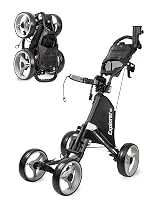
CaddyTek CaddyLite 11.5 V3: Best for frequent car trips
Choose the CaddyTek if lifting and packing the cart are regular parts of your routine. Its aluminum frame weighs 13.75 lb, making it lighter than the Clicgear below.
Its 3-step folding system suits golfers willing to learn a short sequence before the first round. The adjustable handle, foot brake, and elastic upper and lower straps cover the main pushing and bag-securing tasks.
It also includes mesh storage, an umbrella holder, and a drink holder. Skip it if your main need is a built-in phone holder or cooler bag; the JANUS provides those features.
JANUS Pace: Best for phone-guided rounds
Choose the JANUS if you use your phone for yardages and want small items within reach. Its 5-position handle gives you defined height settings to work through during setup.
The one-click folding system suits golfers who want fewer folding steps. Wide EVA wheels and a foot brake support a walking setup, while elastic wing straps accommodate stand bags, cart bags, and 14-way bags.
Skip it if your decision depends on a strict lifting limit or exact trunk clearance. Confirm the cart's own weight and folded measurements before buying; its shipping weight and package size don't answer those questions.
Clicgear Model 4.5: Best for gear-heavy walkers
Choose the Clicgear if you want organized storage and more ways to adjust bag support. Its hand brake also suits golfers who prefer operating the brake from the handle.
The console includes a phone holder with charging cord access, plus holders for a scorecard, balls, pencil, and tees. Multiple accessory mounting points give regular walkers room to build around their usual gear.
Skip it if minimizing lifting weight is your first concern: it weighs 16 lb. Choose it for its bag adjustment and organization rather than assuming a premium cart will automatically suit your routine better.
How should you set up a push cart for the first round?
Set it up at home with your normally packed golf bag. This gives you time to learn the fold and correct the fit before reaching the first tee.
- Open the frame fully and engage its locks according to the manual.
- Seat the bag base on the lower support, with useful pockets facing outward.
- Fasten both bag straps without trapping pockets, zippers, or stand legs.
- Adjust the handle so you can walk upright with relaxed arms.
- Roll a short distance on level ground and check for bag movement or tracking problems.
- Engage the brake and gently confirm it holds before leaving the cart parked.
Keep fingers away from folding joints, and remove loose items before collapsing the frame. Our guide to putting a golf bag on a push cart covers bag placement in more detail.
What mistakes make a push cart harder to use?
The biggest mistakes are poor bag placement, excess weight, and careless parking. Correcting these matters more than adding another accessory.
A top-heavy load can make the cart harder to control. Keep heavier items low in the bag where practical, and avoid hanging heavy extras from the handle.
On hills, keep hold of the cart and move at a pace you can control. Park on level ground where possible, engage the brake, and check that the cart stays put before stepping away.
After a wet round, wipe off mud and let the cart dry before storing it. Clear grass from wheels and folding joints, inspect straps and fasteners, and follow the manual for adjustments or lubrication.
Should you choose a push cart or an electric caddy?
Choose a manual cart if you're comfortable pushing your bag around your usual course. Consider an electric caddy if uphill effort is the part you want powered help with.
A manual cart avoids battery charging and battery storage. An electric caddy adds those tasks, so check the loaded transport routine as carefully as the help it offers during play.
Compare the choices in golf push cart vs electric caddy. Read whether electric golf push carts are worth it if powered assistance is central to your decision.
How can you decide whether a golf push cart is worth it?
A golf push cart is worth it when you'll use it often and can manage it easily before, during, and after play. Borrow first if your walking habits are uncertain or you haven't tried pushing on your course's hills.
Pick the CaddyTek for frequent loading and unloading, the JANUS for phone access and included cooler storage, or the Clicgear for bag adjustment and gear organization. Rule out any model that doesn't fit your packed bag or available space.
Before ordering, measure with your clubs already in the vehicle. Then use our guide to choosing a golf push cart to check the remaining details.
Frequently asked questions
Is a golf push cart worth it for a beginner?
Yes, if you plan to walk regularly and prefer rolling your clubs to carrying them. Being a beginner doesn't make a cart essential, though; borrow or rent one for a round first, then decide whether the easier bag transport is worth the storage and setup.
Is it better to carry a golf bag or use a push cart?
Use a push cart if you want to walk without keeping the bag on your shoulders. Carrying suits a light load, short rounds, and routes with steps or narrow access; consider the full trip, including lifting gear into your vehicle and moving between the parking lot and course.
Can you use a push cart with a stand bag?
Yes, if the stand bag sits securely on the cart's supports and its leg mechanism stays clear of the frame. Fasten both straps and check that pockets remain usable; a bag that twists or slips needs its fit corrected before you head onto slopes or uneven ground.
Should I get an electric caddy instead of a push cart?
Choose an electric caddy when powered help matters more than keeping your setup simple; you still walk, but the motor moves the load. Check battery care, charging space, transport weight, and course rules before choosing one, especially if pushing uphill is the main reason you're considering the change.