How to Choose a Golf Push Cart
To choose a golf push cart, start with bag fit, folded dimensions and a comfortable pushing position. Then match the wheel layout, brake and storage to your course and walking routine.
On this page (9 sections)
- How to choose a golf push cart: what comes first?
- How does wheel layout affect your choice?
- Will your golf bag fit securely?
- How important are folding size and weight?
- What handle and brake features matter?
- Which storage features are worth having?
- How should you set up and care for a push cart?
- What mistakes should you avoid when choosing a cart?
- How to choose a golf push cart you'll use every round
To choose a golf push cart, start with a secure bag fit, a fold that fits your vehicle and a comfortable handle position. Once those needs are covered, compare wheel layout, brake access and the storage you use during a round.
The right choice depends on your whole routine, including loading the trunk and putting the cart away afterward. A phone holder won't make up for a frame that blocks your bag pockets or a folded shape you struggle to lift.
For a wider overview of bag and cart choices, see our golf push carts and stand bags buying guide.
How to choose a golf push cart: what comes first?
Check your bag, storage space and usual course first. These set the requirements that every cart on your shortlist should meet.
Start with your current bag loaded for a normal round. Clubs, drinks and extra clothing change its weight and balance, so an empty bag won't reveal every fit problem.
Measure the space left in your trunk with the bag inside. Include the trunk opening, since a cart can fit the interior yet be awkward to pass through a narrow opening.
Then think about the route you walk most often. Slopes, rough ground, narrow paths and frequent stops make control and secure parking more useful than extra compartments.
Write down your requirements before comparing models:
- Bag fit: supports and straps that hold your bag without blocking pockets.
- Transport: a folded shape and lifting weight you can manage.
- Control: a suitable handle position and reachable brake.
- Course use: wheel layout and clearance suited to your normal route.
- Storage: places for the few items you reach for throughout a round.
Our guide to putting a golf bag on a push cart explains the placement and strap checks. Use those checks to rule out poor matches before choosing accessories.
How should you choose a golf push cart for different routines?
Choose around the part of your routine that creates the most work. Someone with a narrow trunk needs a different priority order from someone who carries drinks, snacks and a phone throughout the round.
If you lift the cart up steps, focus on weight and a secure lifting grip. If you leave it in a garage, folded length may matter less than clear pocket access and convenient controls.
Golfers sharing one cart should check handle adjustment and how easily each bag attaches. A fit that works for one person's height or bag doesn't settle the choice for both.
How does wheel layout affect your choice?
Wheel layout affects the cart's footprint and steering, but wheel count alone doesn't decide stability. Wheelbase, bag position, load distribution and the ground beneath the wheels all matter.
Three-wheel carts have one front wheel and two rear wheels. Four-wheel carts have two front wheels, which can change the space needed around narrow gaps and turns.
Also check whether the front wheels swivel or stay fixed; don't assume a three-wheel cart has a swiveling front wheel. A fixed-wheel design may need a wider turn or a gentle lift of the front end, following its instructions.
Large wheels can help a cart cross small bumps, but they don't remove the need to choose a sensible route. Avoid deep ruts and take uneven sections slowly rather than forcing a loaded cart over an obstacle.
Our 3-wheel vs 4-wheel golf push cart guide explains the trade-offs. You can also browse the push cart guide for other options in this category.
Which 3-wheel cart suits straightforward walking rounds?
The CaddyTek CaddyLite 11.5 V3 suits golfers who want everyday holders and open storage without making a phone console the main attraction. Its mesh net, magnetic pad, drink holder and umbrella holder cover common items used between shots.
Choose it if those simple storage spaces match what you carry and its folded shape fits your car. Skip it if an integrated cooler or dedicated rotating phone holder is central to your routine.
The KVV 3-Wheel Foldable Push Cart suits golfers who prioritize lifting weight, bag support and a compact storage shape. It has ball-bearing wheels, upper and lower elastic straps, and an included umbrella holder.
Choose the KVV if you already keep most small items in your bag. Skip it if you want the included cooler and console setup offered by the more storage-focused options here.
When does the 4-wheel Explorer V8 make sense?
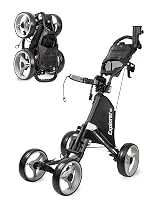
The CaddyTek Superlite Explorer V8 suits walkers who want a four-wheel base and organized storage in one cart. Its adjustable front wheel width lets you center different bags, while the integrated cooler basket and scorecard console keep supplies close.
Choose it if you regularly carry snacks, drinks and small items outside your bag. Its front wheel adjustment is also useful to consider when different golfers share the cart.
Skip it if your main goal is the lowest lifting weight among these measured options. Don't choose it simply because it has another wheel; bag fit and the folded dimensions still need to work.
Will your golf bag fit securely?
Your bag should rest on both supports and stay centered without excessive strap tension. Straps hold a seated bag in place; they shouldn't be used to pull a poorly supported bag into position.
Check the lower cradle against the bag's base. A rounded, angled or bulky base can sit differently from a flat one, even when the strap reaches around it.
Next, check the upper support and pocket openings. You should be able to reach balls, clothing and drinks without loosening a main strap during the round.
Stand bags need extra attention around their folded legs and stand mechanism. See whether a stand bag can go on a push cart for those checks.
Use this fit sequence on level ground:
- Open the frame fully and confirm its locks are engaged.
- Seat the bag base on the lower support.
- Rest the bag against the upper support with pockets facing outward.
- Secure both straps without crushing pockets or pulling against zippers.
- Gently move the handle and check for twisting or slipping.
- Check clearance around stand legs, wheels and folding joints.
If your bag keeps rotating, reposition it before tightening the straps further. An uneven load or a base sitting off-center can cause movement that extra tension won't solve.
The JANUS Pace 3-Wheel Push Cart suits golfers who use a phone during rounds and want small-item storage near the handle. It combines a rotating phone holder with a console, cooler bag, cup holder and mesh storage.
Its elastic wing straps support stand bags, cart bags and 14-way bags, but the shape of your own bag still matters. Choose it for that phone-and-storage setup; skip it if you need confirmed folded measurements before committing to a tight storage space.
If you're replacing the bag too, compare the best golf bags for push carts. Changing both together lets you prioritize accessible pockets and a secure base rather than working around an awkward fit.
How important are folding size and weight?
Folded shape matters as much as weight when loading a cart into a vehicle. A small weight difference may be less useful than dimensions that let the cart sit beside your bag without rearranging everything.
Compare the actual folded measurements rather than package dimensions. Shipping boxes can include detached parts and don't show the shape you'll handle after a round.
| Cart | Folding details | Cart weight |
|---|---|---|
| CaddyTek CaddyLite 11.5 V3 Push Cart | 3-step quad-fold; 28 x 16.5 x 16.1 in folded | About 13.8 lb |
| CaddyTek Superlite Explorer V8 Cart | Two-step fold with locking buckles; about 16.1 x 14.7 x 23.8 in folded | About 15 lb |
| KVV 3-Wheel Foldable Push Cart | 3-step fold; 19.1 x 14.6 x 23.2 in folded | 13.6 lb |
| JANUS Pace 3-Wheel Push Cart | One-click folding | Confirm weight and folded dimensions if space or lifting is a deciding factor |
The CaddyLite's folded shape is longer than the other measured options here. The Explorer and KVV use different proportions, so compare each dimension with the orientation you'll use in your trunk.
Allow space for wet or dirty wheels without pressing them against clothing. A washable mat or separate wheel area can make transport easier without changing which cart you buy.
Also check how the folded frame stays closed and where you can safely grip it. A cup holder, phone mount or loose accessory isn't a lifting handle.
Fold the cart slowly while learning its sequence, keeping fingers away from joints. Fewer folding steps can be convenient, but control placement and a clear locking action matter more than a speed claim.
What handle and brake features matter?
Choose a handle that lets you walk naturally and a brake you can reach in golf shoes. Your arms should feel relaxed rather than stretched forward or held high.
All four carts have adjustable handles and foot brakes. The JANUS handle offers 5 positions, while the KVV brake engages and releases at the left rear wheel.
Handle fit should be checked with the bag attached because the loaded cart is what you'll push. Leave enough room for your normal stride so your shoes don't keep approaching the rear frame.
For a shared cart, check the lowest and highest usable positions rather than assuming any adjustable handle fits everyone. Make sure its lock holds the chosen position before starting.
Use the brake as a parking control, following the cart's instructions. Don't assume a foot parking brake is designed to control speed while moving downhill.
Keep a hand on the handle on slopes and choose level parking spots whenever possible. Before letting go, confirm the brake is engaged and the cart stays still.
Wind also matters when using an umbrella. Lower or remove it in gusty conditions, since a large open canopy can pull against the cart even with the brake engaged.
Which storage features are worth having?
The most useful storage keeps frequently used items accessible without blocking your grip or bag pockets. Start with what you reach for during play, then decide which holders earn space on the cart.
A drink holder helps if reaching into a side pocket is awkward. Check that your usual bottle fits securely rather than assuming every cup holder accepts every shape.
A console is useful for a scorecard, pencil, tees and small personal items. Keep heavier supplies low and centered instead of hanging a full bag from the handle, which can change the cart's balance.
Phone holders deserve a fit check with your case attached. Position the screen where you can glance at it while stopped without covering the handle or interfering with folding controls.
Open mesh storage is convenient for quick access, but it isn't a dry compartment. Keep keys, electronics and other items that need protection in a suitable closed pocket or pouch.
For optional additions, see our guide to golf push cart accessories. Add accessories after confirming the cart and bag work together so you don't crowd the handle with items you rarely use.
How should you set up and care for a push cart?
Secure the frame, wheels and bag before adding accessories, then keep moving parts free of dirt. A short check before each round can catch loose fittings or a strap starting to fray.
Follow the assembly instructions for your exact model. The KVV requires inserting its 3 wheels during initial assembly; confirm each wheel is secured before loading the bag.
Before heading to the first tee:
- Check that the frame is fully open and locked.
- Inspect wheel attachments and clear trapped grass or debris.
- Confirm that straps hold the bag without twisting it.
- Engage and release the brake while holding the handle.
- Secure drinks and small items so they won't fall into moving parts.
After a wet or muddy round, remove grass and wipe dirt from the frame, wheels and brake area. Let the cart dry before leaving it folded in a closed storage space.
EVA wheels don't need air, but they still need inspection for damage and trapped debris. Follow the care instructions for wheel bearings and joints rather than adding lubricant to every moving part.
Avoid directing a forceful water spray at bearings, hinges or storage compartments. If a folding joint resists movement, clear debris and check alignment instead of forcing the frame.
What mistakes should you avoid when choosing a cart?
Avoid choosing by accessories, wheel count or folded volume alone. Each can distract from a basic mismatch that affects every round.
Buying before measuring the trunk is a common mistake. Measure with the golf bag and other regular gear present, including anything that makes the opening narrower.
Another mistake is treating broad bag compatibility as proof of a perfect fit. Strap reach doesn't tell you whether stand legs clear the frame or whether a pocket remains usable.
Don't choose mainly around the lightest stated weight if lifting is already difficult. Folded shape, grip position and how far you must reach into the vehicle also affect the effort.
Finally, don't expect a manual cart to remove the work of moving a loaded bag uphill. It carries the load on wheels, but you still provide the pushing effort and downhill control.
If you're also changing bags, our guide to choosing a golf bag can help you avoid carrying storage capacity you don't need. A better-matched bag can simplify the whole setup.
How to choose a golf push cart you'll use every round
The final decision in how to choose a golf push cart is to pick the model that meets your hardest fit requirement first. Use storage extras to break a tie between carts that already suit your bag, body and vehicle.
Choose the CaddyLite 11.5 V3 for straightforward storage and everyday holders. Choose the Explorer V8 for a four-wheel layout, adjustable front wheel spacing and organized supplies.
Choose the KVV when a lighter cart and its folded proportions suit your transport needs. Choose the JANUS Pace when phone access and console storage lead your priorities, after confirming any measurements essential to your space.
If bag fit remains uncertain, start with the stand bag and push cart fit guide. Once those requirements are clear, compare the best golf push carts with your measurements beside you.
Frequently asked questions
How do I choose a golf push cart?
Choose a golf push cart by checking bag fit, folded dimensions and handle comfort first. Measure your storage space with your golf bag already inside, then compare brake access, wheel layout and useful storage; reject carts that miss a basic fit requirement before weighing smaller extras.
Are 3-wheel or 4-wheel golf push carts better?
Neither wheel layout is best for every golfer; three-wheel carts have one front wheel, while four-wheel carts have two, but wheelbase, bag position and folding shape also matter. Choose the model that holds your bag securely, suits your walking route and fits your vehicle with the rest of your gear.
Will a push cart hold a stand bag?
A push cart can hold a stand bag when its supports and straps match the bag's shape. Seat the base securely, keep folded legs clear of the frame and leave pockets accessible; load the bag as you would for a round, then check for twisting before heading onto the course.
What should I check before buying a folding golf push cart?
Check actual folded dimensions, cart weight, folding steps and any required wheel removal. Measure both the storage area and its opening, allowing room for your bag and dirty wheels; confirm that you can reach the folding controls and lift the cart without using a loose holder as a grip.
Do golf push carts need a brake?
Choose a golf push cart with a parking brake so you can secure it during stops; check that you can engage and release it comfortably in golf shoes, and follow the operating instructions. Park on level ground whenever possible, because a brake does not prevent every kind of sliding or tipping.