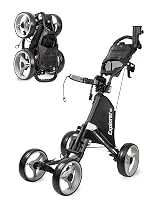
8 Best Electric Golf Push Carts (October 2026)
The best electric golf push carts include the MGI Zip Navigator All Terrain Electric for uneven courses, the MGI Zip Navigator Electric for everyday remote users, and the MGI Zip X5 Electric for handle-guided hill walking.
On this page (8 sections)
- How we chose these electric golf push carts
- The best electric golf push carts for different walking routines
- How do you choose the best electric golf push cart?
- What should you check before buying a powered caddy?
- How should you set up an electric golf push cart?
- What mistakes should you avoid during a round?
- How do you care for an electric golf push cart?
- Which electric golf push cart should you choose?
The MGI Zip Navigator All Terrain Electric is the best electric golf push cart for golfers who regularly walk uneven courses. Its wider platform and downhill cruise control make it our first choice when terrain matters more than lifting weight.
Choose KVV if storage is your main limit, or the MGI Zip X5 if you prefer handle steering. Your best fit depends on how you walk, where you play and how easily you can load the cart.
An electric caddy moves your bag while you walk, but you still steer, choose safe routes and manage charging. It reduces pushing effort without removing the need to pay attention.
If you're deciding whether that help justifies the equipment, read whether electric golf push carts are worth it. Our golf push cart buying guide covers the wider choice of powered and manual designs.
Our picks at a glance
-
1

-
2

-
3

- 4
 Best for compact car storageCheck it
- 5
 Best for lighter handle-guided useCheck it
- 6
 Best for mixed operating stylesCheck it
- 7
 Check it
Bag Boy Volt Electric Push Cart
Best for organized bag access - 8
 Check it
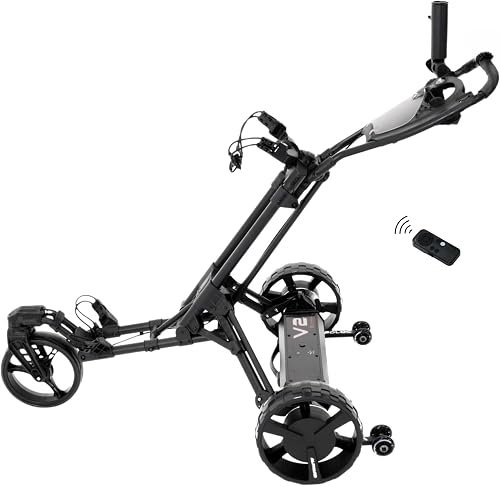
Alphard Omni Electric Cart Bundle
Best for starting from scratch
How we chose these electric golf push carts
We compared control style, slope features, battery range and transport needs to match each cart to a clear buyer. A powered cart should make your walking routine easier from loading the car through the last hole.
Remote steering received weight where it came with tracking or downhill control. Handle models earned their place by offering motor assistance without requiring a separate steering remote.
We also considered practical differences such as a parking brake, manual operation and removable batteries. Folded size matters alongside weight because a cart must fit through your trunk opening as well as inside it.
Manufacturer range figures describe potential use, so they should leave you some margin. We haven't treated a maximum hole count as a promise for every course.
| Product | Best for | Control | Battery range | Weight | Our score |
|---|---|---|---|---|---|
| MGI Zip Navigator All Terrain Electric | uneven courses | Remote or handle, speed settings 1–20 | Up to 36 holes | 37.25 lb with battery | 8.0 |
| MGI Zip Navigator Electric | everyday remote users | Remote or handle, speed settings 1–20 | Up to 36 holes | 34.96 lb with battery | 7.8 |
| MGI Zip X5 Electric | handle-guided hill walking | Handle speed dial, settings 1–20 | Up to 36 holes | 30.57 lb with battery | 7.6 |
| KVV Electric Push Cart | compact car storage | Remote speeds 1–9; manual mode | 18 holes+ | 7.5 | |
| MGI Zip X3 Electric | lighter handle-guided use | Handle speed dial, settings 1–20 | Up to 36 holes | 29.47 lb with battery | 7.4 |
| Wingscaddy Electric Push Cart | mixed operating styles | Remote, trolley and free-wheel | Up to 36 holes | 7.3 | |
| Bag Boy Volt Electric Push Cart | organized bag access | Remote, nine speeds | Up to 36 holes | 6.9 | |
| Alphard Omni Electric Cart Bundle | starting from scratch | Remote and smartphone app | 6.8 |
The best electric golf push carts for different walking routines
The MGI Zip Navigator All Terrain Electric leads for uneven routes, while the other picks solve different control and storage needs. Use the individual write-ups to decide which tradeoff fits your rounds.
MGI Zip Navigator All Terrain Electric
- Remote or handle control
- Up to 36 holes per charge
- All-terrain wheels and rear stabilizer
- 37.25 lb with battery
A wider platform, terrain-focused wheels and downhill cruise control suit golfers who regularly cross uneven ground. Allow for its heavier lift at the car.
Pros
- Remote and handle control
- Gyroscope straight tracking
- Removable battery
Cons
- Heaviest MGI option here
- Folded fit needs checking against your car
Choose the All Terrain Navigator if rough ground is a regular part of your route. Its dual oversized swiveling front wheels, treaded rear wheels and rear stabilizer support that use.
The wider platform is the main reason to choose it over the standard Navigator. Gyroscope straight tracking helps maintain direction, while Downhill Cruise Control addresses speed on descents.
Remote steering lets you walk away from the handle on open stretches. Switch to handle control around parked carts, narrow gaps or crowded staging areas.
The transport tradeoff is substantial: it weighs 37.25 lb with the battery and 31.08 lb without it. Removing the battery divides the load, but the remaining frame still needs a comfortable lift.
Skip this model if your course is mostly smooth and loading weight is your main concern. Its terrain-focused setup makes sense when you'll use those features often, rather than choosing it simply because it tops the roundup.
MGI Zip Navigator Electric
- Remote or handle control
- Up to 36 holes per charge
- 2.5 in LCD display
- 34.96 lb with battery
Choose this Navigator for remote steering and downhill speed control without the All Terrain model's extra weight. Its rear wheels tuck inward for transport.
Pros
- Remote and handle control
- Gyroscope straight tracking
- Rear wheels tuck inward
Cons
- Heavier than the non-remote MGI models here
- Folded dimensions need checking
Choose the standard Navigator if you want remote steering for regular walking rounds without the All Terrain version's extra weight. You retain gyroscope straight tracking, downhill speed control and a fifth-wheel stabilizer.
Its dual 230 W motors work with remote commands for forward, reverse, turning and stopping. The handle also provides direct control when keeping the cart close is more practical.
The 2.5 in display shows cart and remote battery levels. Make checking both part of your pre-round routine, since a charged cart battery doesn't replace attention to the controller.
At 34.96 lb with battery and 28.60 lb without, this is still a sizable item to load. Zip Fold construction and inward-tucking rear wheels help with transport, but confirm folded measurements for your vehicle.
Skip it if you expect to keep a hand on the handle throughout every round. In that case, an X model better matches the way you'll use the cart.
MGI Zip X5 Electric
- Handle speed control 1–20
- Up to 36 holes per charge
- Electronic parking brake
- 30.57 lb with battery
The X5 pairs handle steering with downhill speed control and an electronic parking brake. It suits golfers who want powered help while staying beside the bag.
Pros
- Electronic parking brake
- Downhill speed control
- Lighter than the Navigator models
Cons
- No remote control
- Requires steering from the handle
The Zip X5 suits golfers who want powered movement while steering beside their bag. Its electronic parking brake and downhill speed control make it the more relevant X model for routes with changing elevation.
A start-stop dial sets the pace, and the single 230 W motor supplies assistance. You guide the cart instead of managing directional commands from a remote.
Don't confuse its two slope features: downhill speed control manages movement during a descent, while the parking brake holds the cart when stopped. Follow MGI's instructions for engaging the brake and choosing parking spots.
The X5 weighs 30.57 lb with battery and 25.90 lb without. That gives you a lower lifting load than either Navigator while retaining a removable battery.
Skip it if walking with both hands free is your main reason for buying electric. It fits golfers who want less pushing effort while keeping their clubs and controls close.
KVV Electric Push Cart
- Folds to 17.5 x 18.7 x 22 in
- Remote and manual modes
- 18-hole-plus battery
- 27.9 lb
KVV suits golfers who need a compact folded cart for a usual single round. A manual mode provides another way to move it when powered operation does not fit.
Pros
- Compact folded size
- Height-adjustable handle
- Insulated cooler bag included
Cons
- Shorter stated range than several alternatives
- Less range margin for extended play
KVV is the clearest choice here for a tight trunk or limited home storage. It folds to 17.5 x 18.7 x 22 in and weighs 27.9 lb.
Measure the available space with your golf bag already accounted for. A cart that fits alone may leave little room for clubs, shoes and other gear.
Its height-adjustable handle helps you find a comfortable position for close control. Remote operation provides nine speeds, while manual mode gives you another way to move the cart when battery power is low.
KVV also includes an insulated cooler bag, carry bag and several holders. Keep added supplies modest, since extra load affects how much equipment you move and lift.
Choose it for a usual single round when compact storage drives the decision. Skip it for regular extended play if you want the larger stated battery margin offered by several alternatives.
MGI Zip X3 Electric
- Handle speed control 1–20
- Up to 36 holes per charge
- Controlled distance function
- 29.47 lb with battery
The lighter non-remote MGI option here suits golfers who stay near their clubs. Its controlled distance function adds a way to send the cart forward.
Pros
- Controlled distance function
- Removable battery
- Rear wheels tuck inward
Cons
- No remote control
- No downhill speed control specified
The Zip X3 is a good fit if you want the lighter handle-controlled MGI option in this group. Its controlled distance function adds a way to move the cart forward without making it a remote-steered model.
That distinction matters on the course: sending a cart ahead doesn't give you remote directional control. Use the distance function only with a clear route and room for the cart to stop.
The X3 weighs 29.47 lb with battery and 24.80 lb without. Its rear wheels tuck inward for transport, and the removable battery lets you charge separately from the frame.
Choose it if you normally walk beside your bag and don't need the X5's specified downhill and parking features. For frequent descents, the X5 is the more suitable comparison.
Skip the X3 if remote steering is essential. If your main aim is simply to stop carrying clubs, our CaddyTek CaddyLite 11.5 V3 review covers a manual alternative.
Wingscaddy Electric Push Cart
- Remote, trolley and free-wheel modes
- Dual 200 W motors
- Anti-tip wheel
- Drink and umbrella holders included
Wingscaddy suits golfers who want to switch between remote, trolley and free-wheel use. Timed distance options add another way to move the bag ahead.
Pros
- Three operating modes
- Anti-tip wheel
- Timed distance options
Cons
- Cart weight needs confirming
- Folded dimensions need confirming
Wingscaddy suits golfers who want several operating styles in one cart. Remote, trolley and free-wheel modes let you change how you move the bag during a round.
Its dual 200 W motors and anti-tip wheel support powered use. The wheel adds support, but you should still avoid abrupt turns across slopes or sending the cart onto ground you can't see.
Nine speed settings pair with timed distance options of 10, 20 and 30 meters. Start with the shortest distance on open, level ground while learning how those commands work.
Included equipment covers an umbrella holder, scorecard holder, drink holder and tool kit. You can plan your basic setup without assuming every accessory needs a separate buy.
Choose it if switching between powered and free-wheel use is a priority. Skip it until you confirm the cart's actual lifting weight and folded size if stairs, a high trunk lip or cramped storage control your decision.
Bag Boy Volt Electric Push Cart
- Remote with nine speeds
- Distance control up to 30 yd
- Up to 36 holes per charge
- Folds to 29 x 16.5 x 14.5 in
The Volt suits golfers who want small items close to hand through a storage console and accessory bag. Remote steering, course correction and distance control support powered use.
Pros
- Dedicated console storage
- Mileage tracking display
- Manual mode with battery disengaged
Cons
- One-year manufacturer warranty
- Cart weight needs confirming if lifting matters
The Bag Boy Volt fits golfers who want remote operation with organized access to small gear. Its console and accessory bag provide dedicated places for items such as a phone, tees, balls and scorecard.
TrueLine Tracking provides course correction on uneven terrain. A mileage display adds trip information, while distance control can send the cart up to 30 yd ahead.
Keep distance commands for clear stretches where you can watch the whole route. Near other golfers or path junctions, shorter movements give you more room to react.
The Volt folds to 29 x 16.5 x 14.5 in, and Bag Boy specifies a four-hour charge time. It can also operate manually with the battery disengaged.
Choose it if console access is something you'll use throughout the round. Skip it if you need a longer warranty than Bag Boy's one-year manufacturer coverage, and confirm its weight before buying if lifting ability is a deciding factor.
Alphard Omni Electric Cart Bundle
- Omni Cart and Club Booster V2Pro bundle
- Six-axis gyroscope
- Remote and smartphone app control
- Two-year parts warranty; one year on battery
This complete cart-and-booster bundle suits buyers who need both components. It combines app control with an automatic parking brake and permanently attached wheelie bars.
Pros
- Cart and motorized unit supplied together
- No additional attachment brackets needed
- Automatic parking brake
Cons
- Battery warranty is shorter than parts coverage
- Two components to move and store
The Alphard bundle suits golfers starting without a cart they want to keep. It combines the Omni Cart with the Club Booster V2Pro, avoiding the need to match a separate cart to the powered unit.
The Omni Cart sits on the V2Pro without additional attachment brackets. Permanently attached wheelie bars fold outward for use, and the cart itself has a single-click fold.
Remote and smartphone app control provide steering choices. Alphard's six-axis gyroscope adjusts tracking and pace over bumps and slopes, and the bundle includes downhill speed control and an automatic parking brake.
Think through the loading routine for both components before choosing this design. Separate pieces may suit your storage arrangement, but they still require space and handling.
Skip this complete bundle if you want to retain an existing push cart without replacing it. Alphard covers parts for two years and the battery for one year, so account for that difference when comparing support terms.
How do you choose the best electric golf push cart?
Choose by control style first, then terrain, range and transport. This order removes models that don't suit your walking habits before smaller features distract you.
Which electric golf push cart control style fits you?
Choose remote control if you want to walk independently of the handle on clear stretches. Choose handle control if you prefer staying beside your clubs and adjusting direction directly.
Remote steering still requires your attention. A cart moving ahead can reach a crossing, drainage edge or another group before you do, so stay close enough to stop it promptly.
Handle control offers a different routine: set a comfortable pace, guide the bag and stop as needed. Our electric cart and manual push cart guide helps if you're unsure how much powered assistance you need.
Which slope features match your course?
For regular descents, prioritize downhill speed control over a long list of accessories. For stops on changing ground, look separately for a parking brake.
Tracking systems help maintain direction, while stabilizers and anti-tip wheels add support. None makes steep side slopes, sharp turns or poor bag balance safe.
Plan routes that reduce sideways travel across slopes. When ground looks doubtful, stop and choose a safer line rather than relying on a cart's terrain features.
How much battery margin should you leave?
Choose range for your longest normal outing, including practice-area trips and any extra holes. A cart that barely covers your usual plan leaves less room for changes.
MGI, Wingscaddy and Bag Boy specify up to 36 holes for these models; KVV specifies 18 holes or more. Don't plan two full rounds around a maximum figure without confirming the recommended use conditions.
Alphard's battery range isn't specified here, so confirm it if extended play drives your choice. Manual or free-wheel operation can help you finish moving a bag, but it doesn't replace charging.
Will the cart fit your car and your lifting ability?
Measure the trunk opening and usable interior space with your bag packed. Check whether the folded cart must turn sideways to pass the opening and whether other equipment blocks that movement.
Use folded cart measurements, not shipping-box or assembled dimensions. Also check whether the stated weight includes the battery and any parts you expect to remove.
Picture the full lift from ground level, not just carrying the cart a few steps. Our best golf push carts roundup gives you manual options if powered models exceed a comfortable loading weight.
What should you check before buying a powered caddy?
Confirm bag fit, course permission and charging space before ordering. These practical checks can rule out a poor match faster than comparing another screen feature.
Bag shape affects how securely it sits against the supports. Straps should hold it without blocking pockets or pressing stand legs into an awkward position.
Our guide to putting a golf bag on a push cart explains placement. If your current bag keeps rotating or blocks access, compare golf bags suited to push carts before replacing the whole setup.
Ask your course about powered walking carts and any restricted areas. Our guide to push cart rules at golf courses covers what to ask before arrival.
Check where you'll charge and store the battery according to its manual. Review warranty registration too: MGI asks buyers to register within 30 days, and its terms may require the original carton for service.
How should you set up an electric golf push cart?
Start with a full charge, a secured bag and a low speed setting. Learn the controls in a clear, level area before joining a busy first tee.
- Unfold the frame and confirm all locks and wheels are secure.
- Fit the battery and deploy any stabilizer or wheelie bars as directed.
- Center the bag, fasten its straps and tuck away loose ends.
- Check controller power, then learn start, stop and turning commands.
- Practice a short movement and stop before increasing speed.
Recheck bag straps after the first few movements. Water bottles, extra clothing and loosely packed pockets can shift the load even when the bag initially feels secure.
For remote models, keep the controller where you can reach the stop command quickly. Avoid placing it loose in a pocket where another object could press a button.
Choose accessories around your routine rather than filling every attachment point. Our guide to golf push cart accessories helps separate useful additions from gear you'll rarely use.
What mistakes should you avoid during a round?
Avoid excess speed, blind distance commands and unattended slopes. Most of these mistakes come from treating powered movement as a reason to stop watching the cart.
Set the pace to your walk instead of chasing the bag. Slow down before turns, narrow paths and rough patches so you have time to correct direction.
Don't send the cart over a rise or around a corner where you can't see the landing area. A clear first few yards doesn't mean the whole route is clear.
Park on level ground when possible and use the cart's specified stopping method. Downhill speed control isn't a substitute for a parking brake, and a stabilizer isn't permission to leave a cart across a slope.
Treat umbrella use with care in wind because it adds a large surface above the cart. Remove or close it when conditions make the cart harder to control.
How do you care for an electric golf push cart?
Keep wheels, folding joints and battery connections clean, following the model's care instructions. Small amounts of regular attention help prevent dirt from interfering with moving parts.
After a wet or muddy round, remove loose debris and let the cart dry before storage. Avoid pressure washing electrical areas or assuming a weatherproof battery means the entire cart can be soaked.
Inspect straps, wheel attachments and folding locks before the next outing. If steering or rolling changes, check for trapped debris and follow the manual rather than forcing the mechanism.
Use the specified charger and follow the battery's charging, temperature and storage instructions. Charge the remote as required too, and replace charging equipment only with an approved match.
Which electric golf push cart should you choose?
The best electric golf push cart is the one that solves your main walking problem and still fits your loading routine. Choose by the limitation you face most often:
- Uneven routes: MGI Zip Navigator All Terrain Electric.
- Regular remote use: MGI Zip Navigator Electric.
- Handle steering on changing elevation: MGI Zip X5 Electric.
- Tight storage: KVV Electric Push Cart.
- Lighter handle-guided MGI setup: MGI Zip X3 Electric.
- Several operating modes: Wingscaddy Electric Push Cart.
- Console storage and remote use: Bag Boy Volt Electric Push Cart.
- A complete cart-and-booster system: Alphard Omni Electric Cart Bundle.
Before ordering, settle three details: where the folded cart will go, how you'll lift it and where the battery will charge. If those steps still feel like more work than the motor saves, use our electric caddy value guide to compare the full routine.
Our top 3 picks at a glance
-
1
-
2
-
3
Frequently asked questions
What is the best electric golf push cart for hills?
The MGI Zip Navigator All Terrain Electric is our first choice for uneven or hilly courses in this group. Its wider platform, terrain-focused wheels, rear stabilizer and downhill cruise control make it the strongest fit; choose safe routes and stay close on slopes because support wheels cannot prevent every tip.
Do electric golf carts come with a remote?
Some electric golf push carts include a remote, while others use handle controls. The MGI Navigator models, KVV, Wingscaddy, Bag Boy Volt and Alphard bundle include remote control; the MGI Zip X3 and X5 use handle controls, so choose them if you prefer to stay beside the bag.
How far can an electric golf push cart run on one charge?
MGI, Wingscaddy and Bag Boy give their carts here ranges of up to 36 holes, while KVV specifies 18 holes or more. Terrain, load and use affect the margin available; start with a full charge and avoid planning an extended round around the maximum stated range.
How do you choose between an electric caddy and a manual push cart?
Choose an electric caddy if reducing the effort of moving your bag matters enough to justify charging, lifting and storage. A manual cart suits golfers who want fewer setup steps and no battery routine; our electric caddy versus push cart comparison explains how those tradeoffs affect a normal round.