Golf Push Cart vs Electric Caddy: Is the Upgrade Worth It? (October 2026)
In a golf push cart vs electric comparison, choose manual for lighter lifting and simpler care or electric to reduce pushing effort. Pick direct steering or remote control based on how you want to manage the cart.
On this page (11 sections)
- Golf push cart vs electric caddy: what changes?
- Who should buy a manual cart, and who should skip it?
- When is an electric caddy worth the extra routine?
- Which of these 3 carts fits your walking style?
- Which cart is easier to lift and store?
- How do direct steering and remote control compare?
- What matters most on hills and uneven ground?
- How should you set up your bag before the first round?
- What care does each type need?
- Which buying mistakes should you avoid?
- Golf push cart vs electric: which should you choose?
Choose a manual push cart for simpler ownership and lighter lifting, or an electric caddy for less pushing effort. The golf push cart vs electric decision comes down to where you want to save effort: loading your gear or moving it around the course.
A motor helps move your bag, but you still walk, steer or supervise the cart, and manage stops. That distinction matters if you're expecting powered movement to make the whole round effortless.
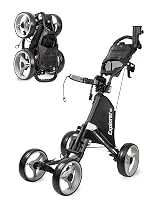
The CaddyTek below suits golfers who are happy pushing. The MGI adds power with direct steering, while the Wingscaddy adds remote operation.


Golf push cart vs electric caddy: what changes?
A manual cart relies on your pushing force, while an electric caddy uses a motor to move the load. Both carry your bag so you can walk without carrying it on your shoulders.
With manual movement, your pace and the cart's pace stay closely linked. You push forward, guide turns and use the brake when parking.
With electric movement, you set the pace through the controls. You must also slow or stop the cart before tight turns, crowded areas and obstacles.
Electric doesn't automatically mean remote control. Some powered carts keep you at the handle, which can suit golfers who want assistance without managing a cart farther ahead.
If you're also choosing a bag, start with our complete guide to golf push carts and stand bags. A well-matched bag and cart make loading, access and balance easier.
Who should buy a manual cart, and who should skip it?
Buy manual if pushing feels comfortable and you value a simple routine. It suits occasional walkers, golfers on flatter courses and anyone who regularly lifts equipment into a car or carries it up steps.
A manual cart also makes sense if you decide to walk at short notice. There's no battery charge to check before leaving home.
Think about your usual round rather than one unusually easy course. Long uphill paths, soft ground and a heavily packed bag all increase the work you supply.
Skip manual if the effort of pushing is already making you avoid walking rounds. Buying a lighter frame won't remove the need to move the bag and its contents uphill.
Before changing carts, remove gear you rarely use. Extra balls, spare clothing and unused accessories add to the load regardless of which cart you choose.
For a closer look at the basic ownership decision, see whether a golf push cart is worth it.
When is an electric caddy worth the extra routine?
Choose electric when reducing pushing effort will help you walk more often. It makes the most sense for regular walkers who accept charging, heavier transport and more equipment to maintain.
Separate the walking from the pushing when judging the benefit. If you enjoy the walk but dislike moving a full bag, a motor addresses that specific problem.
If walking the distance is the main difficulty, a powered bag carrier still leaves that distance to cover. Choose your round length and transport around what you can comfortably manage.
Golf push cart vs electric: does your weekly routine favor power?
Frequent walking rounds give powered assistance more chances to be useful. Count the rounds you actually walk, then consider the charging and loading steps each one would require.
A convenient charging location matters. If your gear stays far from a suitable outlet, a removable battery can make the routine easier.
Skip the upgrade if you rarely walk, already find pushing easy or would struggle to load the cart. Our guide to whether electric golf push carts are worth it explores that tradeoff further.
Which of these 3 carts fits your walking style?
Choose the CaddyTek for manual simplicity, the MGI for powered handle control or the Wingscaddy for remote operation. These are different ways to manage your bag, so choose the control style before comparing accessories.
CaddyTek CaddyLite: for golfers who prioritize loading ease
The CaddyTek weighs 13.75 lb and has a 3-step quad-fold frame. Its folded size is 28 x 16.5 x 16.1 inches, giving you concrete measurements to compare with your storage space.
The adjustable handle lets you set a comfortable pushing position. A foot brake handles parking, while upper and lower elastic straps secure the bag.
Its aluminum frame rides on 3 EVA wheels, with 11.5-inch rear wheels and a 10.5-inch front wheel. Included storage consists of a mesh net, magnetic pad, umbrella holder and drink holder.
Buy it if low transport weight and straightforward operation matter most. Skip it if your main goal is to stop supplying the force that moves a loaded bag.
MGI Zip X3: for golfers who want power at the handle
The MGI uses a single 230 W motor with speed settings from 1 to 20. You steer directly, using the start-stop dial to manage movement.
Its 2.5-inch LCD display shows battery levels, and a controlled-distance function adds another movement option. MGI says the removable lithium battery supports up to 36 holes per charge; a charger is included.
The USB port can supply power to a phone or device during use. MGI backs the cart with a 3-year manufacturer warranty, with registration required within 30 days and coverage subject to its terms.
Buy it if you want motor assistance while remaining close to the handle. Skip it if remote operation is essential or the transport weight would make loading difficult.
Wingscaddy: for golfers who specifically want a remote
The Wingscaddy offers remote, trolley and free-wheel modes, with 9 speed settings. Dual 200 W motors provide propulsion, and an anti-tip wheel is included.
Its accessories include an umbrella holder, scorecard holder, drink holder and tool kit. These cover common on-course needs without making accessories the main reason to choose it.
Buy it if remote operation is the feature you want. Skip it if you prefer to keep every movement under direct handle control or don't want to supervise a moving cart at a distance.
Confirm the actual cart weight and folded dimensions before buying. Package measurements and shipping weight won't tell you how easily the assembled cart fits your car.
Which cart is easier to lift and store?
The CaddyTek is the lighter lift here, while the MGI lets you remove its battery for separate handling. Check the whole loading movement, including reaching into your trunk and lifting over its edge.
The MGI weighs 29.47 lb with the battery and 24.80 lb without it. Its rear wheels tuck inward for transport and storage, but you still need room for the folded frame and your bag.
Measure the trunk opening as well as the space inside. Leave clearance for your hands, and consider whether other golf gear will already occupy that area.
At home, decide where wet wheels and the folded frame will go. An electric setup also needs a suitable battery charging location that follows the manufacturer's instructions.
If you share a car, check the fit with the usual passenger seats and cargo in place. A cart that fits only after a major rearrangement can become a reason to leave it behind.
How do direct steering and remote control compare?
Direct steering suits close control; remote operation suits golfers who want to walk away from the handle. Neither removes your responsibility to watch the cart and leave room to stop.
With a handle-controlled electric cart, start at a low speed and adjust until it matches your natural pace. Avoid setting a pace that makes you stretch forward or hurry to keep up.
For remote use, learn the stop command before sending the cart ahead. Keep it within clear view and bring it close before approaching bridges, narrow paths or groups of golfers.
Practice turns and stops in an open, level area before your first round. Learn any distance function there too, rather than trying it near a bunker or another player's equipment.
Don't assume remote operation includes automatic following. Remote commands and following a golfer are different functions.
What matters most on hills and uneven ground?
Slope limits, route choice and stopping controls matter more than motor count. Uphill assistance doesn't tell you how a cart will behave downhill or across a side slope.
The MGI has swiveling front wheels, all-terrain rear wheels and a fifth-wheel stabilizer. The Wingscaddy has an anti-tip wheel, but these supports don't make either cart safe on every incline.
Read the model's instructions for permitted slopes, downhill control and parking. Don't assume an electric cart has automatic downhill braking simply because it has powered movement.
Favor a clear, gradual route over a shortcut across a steep bank. Slow down before roots, ruts and sharp turns, and keep the load centered.
Park on level ground where possible, following the cart's stopping instructions. Avoid leaving any cart pointed toward water, traffic or a steep drop.
How should you set up your bag before the first round?
Fit and secure the bag before adjusting your walking pace or adding accessories. A bag that twists or sits unevenly can make either cart harder to manage.
Seat the base fully in its support, then position the upper support so it holds the bag without crushing pockets. Fasten both straps and check that zippers remain usable.
CaddyTek says its straps fit most golf bags, including oversized or irregular shapes. Compatibility still depends on how your particular bag sits against the supports.
For stand bags, keep the legs clear of wheels, straps and frame joints. Our guide to using a stand bag on a push cart explains the fit checks.
Use the golf bag setup guide for strap placement. After loading, roll a short distance on level ground and recheck for shifting before starting your round.
What care does each type need?
Both need clean wheels, secure fittings and dry storage; electric carts also need battery care. A short routine after each round is easier than dealing with packed mud or a forgotten charge next time.
Brush away grass and dirt, then wipe the frame and wheels as the manual directs. Check folding locks, straps and wheel attachments before putting the cart away.
For electric equipment, follow the cleaning instructions around motors, controls and battery connections. Don't direct a pressure washer or hose at electrical parts.
Use the approved charger and follow the brand's charging and storage guidance. Plan charging around your next round rather than assuming a partly used battery has enough capacity left.
Treat a claimed hole range as a planning guide. Slopes, load, ground conditions and battery condition can change how far a charge takes you.
Which buying mistakes should you avoid?
Avoid choosing by motor features alone or assuming the cart will fit your existing routine. Transport, bag fit and control preference can matter more than an extra accessory.
- Confusing electric with remote: Check how you steer and stop the exact model.
- Comparing shipping weight with cart weight: Packaging isn't part of the load you lift each round.
- Buying for rare double rounds: Base battery needs on your normal play, with sensible reserve.
- Ignoring downhill operation: Learn the stopping controls before choosing a cart for a hilly course.
- Adding too much gear: A motor doesn't remove storage limits or the need to balance the bag.
- Leaving course rules until arrival: Confirm where carts are allowed before bringing a new setup.
If you're still narrowing your priorities, use our guide to choosing a golf push cart to work through fit, folding and daily use.
Golf push cart vs electric: which should you choose?
Choose the cart whose routine you can repeat comfortably every round. For this golf push cart vs electric decision, first check loading and storage, then choose how much help you want on the course.
Pick the CaddyTek if pushing is comfortable and lighter transport matters most. Choose the MGI if you want powered movement with direct steering, or the Wingscaddy if remote operation is your priority.
Before buying, settle 3 details: where it will fit, how you'll secure your bag and how you'll control it on your usual course. For a wider shortlist, compare our best golf push carts and best electric golf push carts.
Frequently asked questions
Is an electric golf caddy worth the upgrade?
An electric caddy is worth considering when pushing your loaded bag makes walking rounds less appealing; the motor handles propulsion, while you still walk and manage the cart. Choose manual if pushing feels comfortable and you value a lighter lift, simpler storage and no charging routine.
Can an electric caddy be used without power?
The Wingscaddy includes a free-wheel mode, but learn how to engage it before relying on unpowered use; don't assume every electric cart works the same way. For the MGI Zip X3, confirm the unpowered operating procedure with MGI and plan how you would finish a round after a depleted battery.
Which is easier to lift into a car?
The CaddyTek is the lighter lift here at 13.75 lb, compared with 29.47 lb for the MGI with its battery; removing the MGI battery reduces its cart weight to 24.80 lb. Also check your trunk opening, lifting height and folded clearance, since weight alone doesn't determine loading ease.
Do electric golf caddies work on hills?
Electric golf caddies can assist with uphill movement, but suitability depends on each model's slope limits and stopping controls. The MGI has a fifth-wheel stabilizer, and the Wingscaddy has an anti-tip wheel; neither feature replaces careful route choice, correct bag loading or the operating instructions for descending and parking.
Will my golf bag fit either cart?
CaddyTek says its elastic straps fit most golf bags, but check the supports and strap positions on any cart you choose; stand legs, pocket openings and the bag base need clearance. Our guide to putting a golf bag on a push cart explains how to secure the bag without blocking access.