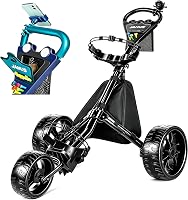
Are Electric Golf Push Carts Worth It?
Electric golf push carts are worth it for frequent walkers who want less pushing, especially on demanding courses. Choose a manual cart if loading weight, charging, or occasional use makes motor assistance less useful.
On this page (6 sections)
- Are electric golf push carts worth it for regular walkers?
- Which cart fits the way you want to walk?
- What should you check before buying an electric cart?
- How should you set up and care for an electric caddy?
- What mistakes reduce the value of an electric cart?
- Are electric golf push carts worth it for your routine?
Electric golf push carts are worth it if you walk regularly and want to stop pushing a loaded bag, especially on a demanding course. They still require charging, loading, and careful control, so the upgrade needs to fit your routine beyond the fairway.
Buy for the rounds you actually walk, not the walking schedule you hope to start. A manual cart remains a sensible choice when pushing feels easy or lifting heavier equipment into your car would be a bigger burden.
Are electric golf push carts worth it for regular walkers?
They offer the most value to frequent walkers whose main complaint is pushing their bag. Motor assistance addresses that specific task while leaving you free to walk the course.
Think about where your effort goes during a round. If moving the bag uphill wears you down, assistance can be useful; if the walking distance itself is the problem, an electric caddy doesn't shorten it.
Frequency matters because every outing spreads the buying cost across another use. Divide the extra cost over a comparable manual cart by your expected walking rounds to judge whether the convenience feels worthwhile.
Include battery replacement and servicing in your budget planning. For a wider view of walking equipment and bag choices, start with our golf push cart guide.
When are electric golf push carts worth skipping?
Skip electric if you seldom walk, have no convenient charging space, or struggle to load the cart. Those drawbacks can outweigh the effort saved between shots.
A cart that fits your trunk can still be awkward to lift over its opening. Check both the storage space and the lifting motion before committing to a heavier setup.
Which cart fits the way you want to walk?
Choose by control style and transport needs first, then compare battery capacity and accessories. These 4 options serve different routines, including golfers who decide to stay with manual pushing.
MGI Zip X3: for golfers who want to steer beside the bag
The MGI Zip X3 suits golfers who want motor assistance while keeping control at the handle. It's non-remote, with a start-stop speed dial offering settings from 1–20 and a controlled-distance function.
MGI claims up to 36 holes per charge, making it worth considering for longer outings. Its removable battery also lets you charge separately from the frame, provided you follow the charging instructions.
It weighs 29.47 lb with the battery and 24.80 lb without it. Removing the battery splits the load, but the frame still needs to be manageable when lifting.
Skip this model if remote steering is essential or the frame weight exceeds what you can comfortably handle. Its fifth-wheel stabilizer supports balance, but careful route choice still matters.
KVV Electric: for remote users with limited storage space
The KVV Electric Push Cart suits golfers who want remote control and need a defined storage footprint. It folds to 17.5 x 18.7 x 22 in and weighs 27.9 lb.
KVV claims 18 holes or more from its battery, so it fits a single-round routine more clearly than an uncharged double round. Manual mode provides a way to keep moving when motor assistance isn't practical.
The remote offers speeds from 1–9, while the adjustable handle gives you another way to guide it. A rotating front wheel, 2 training wheels, and Straight Line Tracker help with turning and directional control.
Skip it if your normal outing requires 36 holes without charging. Measure your trunk with your bag already inside rather than judging storage from the cart's folded dimensions alone.
Wingscaddy Electric: for golfers who want several operating modes
The Wingscaddy Electric Push Cart suits golfers who want remote, trolley, and free-wheel modes in one cart. That choice matters if you expect to alternate how you guide the bag during a round.
It has dual 200 W motors, an anti-tip wheel, and 9 speed settings. Its timed advance function offers 10, 20, and 30 m distances, which calls for a clear route before sending it ahead.
Wingscaddy claims up to 36 holes of battery range. Don't choose it solely because of motor wattage, since wattage alone doesn't guarantee hill limits or downhill control.
Skip it if you need confirmed lifting weight and folded dimensions before buying until you have those measurements. Package weight and carton size aren't substitutes for the cart's transport measurements.
CaddyTek CaddyLite 11.5 V3: for simpler loading and occasional walking
The manual CaddyTek CaddyLite 11.5 V3 suits golfers who want bag support without charging or motor controls. At about 13.8 lb, it's substantially lighter to lift than the MGI and KVV options above.
Its quad-fold frame, adjustable handle, and foot brake cover the basic transport and control tasks. You supply all the pushing effort, so skip it if reducing that effort is your main reason for changing carts.
Our guide to whether a golf push cart is worth it helps compare manual pushing with carrying. The electric caddy versus push cart comparison focuses on the upgrade itself.
What should you check before buying an electric cart?
Check course access, battery margin, bag fit, and service support before choosing accessories. A holder or cooler bag won't compensate for a cart that doesn't suit your route or storage space.
Match battery capacity to your longest normal outing
Choose enough range for your usual longest day, with room for harder conditions. Hills, a heavier load, and battery condition can affect how far a charge takes you.
An “up to” distance is a planning limit, not a reason to arrive with a partly charged battery. If you regularly play beyond one round, choose for that routine rather than assuming you'll find somewhere to recharge.
Confirm course rules and slope guidance
Ask your course about personal electric caddies and any route restrictions before buying. Our guide to whether golf courses allow push carts explains what to ask.
Follow each cart's slope instructions and keep it away from banks, water edges, and steep side slopes. Stabilizing wheels don't turn every route into a safe route.
Check your bag and storage together
Your bag should sit securely without blocking straps, controls, or folding parts. Stand-bag legs and the shape of the base can affect how well it rests on a cart.
Check pocket access with the bag strapped in place. Our best golf bags for push carts guide helps if your current bag twists or sits poorly.
Understand support before you need it
Check warranty terms, battery replacement options, and the repair process. MGI backs the Zip X3 with a 3-year warranty, with registration within 30 days required under its policy.
Ask how repairs are handled and whether you need to retain packaging. A clear service route matters more than an accessory you'll rarely use.
How should you set up and care for an electric caddy?
Start with a charged battery, a secure bag, and slow control practice. Learn the stopping controls before using distance functions or directing a remote cart along narrow paths.
- Unfold and check the frame. Confirm locks, wheels, and the battery connection are secure according to the manual.
- Balance and strap the bag. Keep heavy items low and avoid hanging extra loads from the handle unless permitted.
- Practice on clear, level ground. Learn start, stop, turning, and any manual or free-wheel procedure.
- Set a comfortable pace. Begin slowly and reduce speed before turns or rough ground.
- Clean and recharge after the round. Remove grass and mud, then follow the battery's charging and storage instructions.
Our guide to putting a golf bag on a push cart explains bag placement. Keep electrical connections dry and avoid directing a pressure washer at the motor or battery area.
Don't leave a battery depleted for extended storage or improvise with another charger. Follow its specific care instructions, since charging and storage requirements vary.
What mistakes reduce the value of an electric cart?
The biggest mistakes are buying features you won't use and overlooking daily handling. Focus on the tasks you'll repeat every round.
Don't confuse remote control with automatic following. Keep watching the cart and its route, especially around other players, bridges, and hazards.
Avoid choosing by folded size alone or assuming an anti-tip wheel removes rollover risk. Also learn any manual mode before you need it, rather than discovering its controls after power runs low.
For a broader checklist, read how to choose a golf push cart.
Are electric golf push carts worth it for your routine?
Electric golf push carts are worth it when frequent use and less pushing outweigh charging and loading work. Make the decision around your course, your car, and the way you prefer to control the bag.
Choose MGI for handle steering, KVV for remote control with a compact fold, or Wingscaddy for its range of operating modes. Choose CaddyTek if lighter loading and a simpler routine matter more than motor assistance.
Before ordering, settle 3 questions: can you comfortably load it, store and charge it, and use it on your regular course? If all 3 fit, compare the best electric golf push carts to narrow your choice.
Frequently asked questions
Are electric golf push carts worth the extra cost?
Electric golf push carts are worth the extra cost when frequent use and reduced pushing justify the added expense; count how many rounds you actually walk, then consider charging, storage, and lifting. If you rarely walk or find manual pushing easy, a manual cart is the stronger choice.
Do electric golf push carts work on hills?
Electric golf push carts can help move a bag uphill, but slope limits and downhill control depend on the model; stabilizers and anti-tip wheels don't prevent every rollover. Follow the manufacturer's slope guidance, slow down before turns, and stay close on uneven ground rather than sending the cart far ahead.
How many holes can an electric golf push cart handle?
Battery range depends on the cart and course conditions; MGI claims up to 36 holes per charge for the Zip X3, while KVV claims 18 holes or more for its electric cart. Choose enough capacity for your longest usual outing, allowing for hills, bag weight, and battery condition.
Should I choose a remote-control or handle-steered electric caddy?
Choose remote control if you want to walk without holding the handle and are comfortable steering with a separate device; choose handle steering if you prefer direct control beside your bag. Remote operation still needs your attention, especially near water, other golfers, tight turns, and steep or uneven ground.