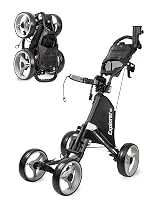
CaddyTek vs KVV Golf Push Cart: Which Is Better? (October 2026)
In the CaddyTek vs KVV comparison, choose CaddyTek for accessible storage or KVV for a shorter, narrower folded shape. CaddyTek folds lower, so match the cart to your trunk before choosing.
On this page (11 sections)
- CaddyTek vs KVV: which cart fits your storage space?
- Which cart will feel better during a walking round?
- Who should buy CaddyTek, and who should skip it?
- Who should buy KVV, and who should skip it?
- Which cart suits your golf bag?
- How should you set up the cart before your first round?
- How do you keep either cart working well?
- Which buying and use mistakes should you avoid?
- Does the JANUS Pace make sense as an alternative?
- When should you skip both main carts?
- CaddyTek vs KVV: make the final choice
In the CaddyTek vs KVV choice, buy CaddyTek for accessible accessory storage and KVV when its shorter, narrower folded shape fits your space better. CaddyTek folds lower, which can make it the better match beneath a cargo cover.
Both cover the essentials for walking golf: bag support, handle adjustment and a parking brake. The useful differences are how they pack, where your small items go and how each fits your loaded bag.
JANUS Pace is the alternative for golfers who want phone access and more storage at the handle. Start with the 2 main carts, then consider JANUS if those extras solve a need.


CaddyTek vs KVV: which cart fits your storage space?
KVV needs less folded length and width; CaddyTek needs less height. Neither is smaller in every direction, so choose the shape that works with your trunk, locker or garage shelf.
CaddyTek folds to 28 x 16.5 x 16.1 inches, while KVV folds to 19.1 x 14.6 x 23.2 inches. Both use a 3-step folding process, with CaddyTek describing its system as a quad-fold frame.
The shorter package can help when a golf bag already uses much of the cargo length. The lower package can help beneath a shelf or cargo cover, provided there is enough room for its longer frame.
Don't use shipping-carton measurements to plan storage. The space occupied by packaging is different from the folded cart you will load after each round.
CaddyTek vs KVV trunk fit: measure the whole route
Measure the opening and the resting space, since a cart can fit inside a trunk yet be awkward to pass through its mouth. Include hinges, a raised cargo lip and any fixed shelf that limits the angle of entry.
Use a tape measure to map the folded shape in your intended orientation. Rotating the package changes which dimension acts as its height, but it may also put wheels against your bag or block access to other gear.
Plan around your normal golf load, including shoes, rain gear and any other bag sharing the trunk. Leave hand clearance so you can lift the cart without scraping your knuckles or dragging the frame across the trim.
Our golf push cart buying guide covers the other fit checks worth making before you order.
Which cart will feel better during a walking round?
Handle fit and a secure bag matter more than the small weight gap. KVV weighs 13.6 pounds, while CaddyTek weighs about 13.8 pounds, a difference of roughly 0.2 pounds.
That gap is too small to justify giving up a better storage fit. For loading, consider how far you must reach across the trunk lip and whether you can lift the folded frame close to your body.
Both carts have height-adjustable handles. Set the grip so you can walk upright with relaxed shoulders and slightly bent elbows, without shortening your stride to avoid the frame.
A handle set too low encourages bending forward. One set too high can make you push with raised shoulders, so adjust it with your bag loaded rather than judging the empty cart alone.
What do the wheel differences mean?
CaddyTek has a 10.5-inch front wheel, compared with KVV's 9.5-inch front wheel. Both have 11.5-inch rear wheels and EVA wheels, while KVV also specifies ball bearings.
A larger wheel generally meets small edges at a gentler angle, making CaddyTek worth considering for uneven paths. It doesn't guarantee a winner for every surface because bag weight, ground softness and slope also affect pushing effort.
On rough ground, slow down before roots, ruts and path edges instead of forcing the front wheel through them. Keep both hands available when the route becomes uneven.
If your main concern is wheel layout rather than these models, read 3-wheel vs 4-wheel golf push carts.
Who should buy CaddyTek, and who should skip it?
Buy CaddyTek if you want frequently used items near the handle and its folded shape fits your car. Its magnetic pad, mesh net, umbrella holder and drink holder give separate places for common round essentials.
The magnetic pad is useful if you already use compatible magnetic accessories. Check the accessory's attachment and keep it clear of moving joints rather than assuming any small item will stay there.
The mesh net suits items you want to reach without opening a bag pocket. Keep valuables in a secure pocket when bouncing over rough ground, since open storage is best for quick access.
CaddyTek also makes sense when low storage clearance matters more than a short folded length. Its aluminum frame comes with a 1-year limited warranty covering manufacturing defects and workmanship under normal use.
Skip CaddyTek if its longer folded frame makes loading awkward. A magnetic pad is a weak reason to choose a cart that forces you to rearrange the trunk after every round.
Golfers who keep everything in their bag may get little use from the extra storage points. In that case, bag fit and folded shape should decide the purchase.
Who should buy KVV, and who should skip it?
Buy KVV if your space favors a shorter, narrower folded package and you already keep most gear in your golf bag. Its umbrella holder and scorecard holder cover useful on-course tasks without making storage extras the main attraction.
The height-adjustable handle offers multiple pushing positions. That makes it worth considering for a shared cart, provided each user can find a comfortable grip height.
Initial assembly calls for inserting the 3 wheels. Before the first round, follow the manual's wheel-fitting steps and confirm each wheel is retained before loading your bag.
Skip KVV if your storage space has a low height limit that its folded shape cannot clear. Don't assume the shorter length means it will fit beneath every cargo cover.
It is also a weaker match if a magnetic attachment point and separate mesh storage are central to your routine. Decide which items need a place before buying extra accessories to recreate another cart's layout.
Which cart suits your golf bag?
Choose the cart that supports your loaded bag without twisting or blocking access. Both main carts use upper and lower elastic straps, but strap reach alone doesn't prove a good fit.
CaddyTek describes compatibility with most golf bags, including oversized or irregular shapes. KVV uses upper and lower brackets with elastic straps to accommodate different bag sizes.
Place the bag's base fully on the lower support before securing the upper section. A bag hanging mainly from its straps can shift as you turn or cross a bump.
Check the stand mechanism if you use a stand bag. Its legs should remain folded and clear of the frame, wheels and brake.
Face the pockets you use most toward an accessible side. Avoid routing straps over zippers or tightening them so hard that they crush a pocket full of balls or personal items.
Try a slow turn with the bag loaded as it will be for a round. If the bag rotates, reseat it and adjust the straps instead of adding more force at the handle.
Our guide to putting a golf bag on a push cart explains the sequence. If you are choosing a bag too, compare stand bags and cart bags before committing.
How should you set up the cart before your first round?
Learn the fold, brake and bag attachment at home so setup at the course is quick and familiar. Use the manual for the exact latch sequence, since forcing an unfamiliar joint can damage the mechanism.
Start on level ground with room around the frame. Keep fingers away from hinges, open the cart fully and confirm its locks are engaged before adding the bag.
Next, secure the loaded bag and adjust the handle. Roll a short distance on level ground to check for bag movement, wheel wobble or straps hanging near the wheels.
Learn how the brake engages and releases before parking on a slope. CaddyTek uses a foot-activated brake, while KVV's pedal operates the left rear wheel's brake.
Apply the parking brake whenever you stop, and choose level ground when available. Keep control of the handle until you are sure the cart stays put.
Before folding, remove loose gear and check whether attached accessories must be moved or removed. Secure dangling straps so they don't get trapped in the folding joints.
How do you keep either cart working well?
Clear dirt from moving parts and store the cart dry. Grass and grit around wheel mounts, hinges and the brake can interfere with normal movement even when the frame looks clean.
After a muddy round, brush away loose debris and wipe the frame and wheels. Follow the manual for cleaning methods, and avoid directing a strong water jet into bearings or brake parts.
Let wet straps and storage fabric dry before putting the cart away. A closed trunk is a poor place to leave damp gear between rounds.
Inspect wheel retention, fasteners and strap condition regularly. Stop using the cart if a wheel is loose, a lock won't engage or the brake no longer holds as expected.
KVV describes its EVA-covered wheels as maintenance-free, but they still need dirt removal and routine checks. Don't add lubricant to bearings or brake surfaces unless the care instructions call for it.
Which buying and use mistakes should you avoid?
Don't buy around a single headline feature while ignoring daily loading and bag fit. A cart earns its place by being easy to bring, unfold and use throughout the round.
Avoid these common mistakes:
- Choosing by weight alone. A tiny difference matters less than an awkward lift or poor grip position.
- Measuring an empty trunk. Include the golf bag and other gear that travel with you.
- Overloading handle storage. Keep heavier items low in the bag so they don't add unnecessary weight high on the cart.
- Treating the brake as a downhill speed control. Use it for parking and maintain control while moving.
- Forcing a reluctant fold. Look for a trapped strap, accessory or latch before pushing harder.
- Buying accessories before identifying a need. Confirm the mounting fit and whether the item will interfere with folding.
Our guide to which accessories a golf push cart needs can help you choose useful additions without crowding the handle.
Does the JANUS Pace make sense as an alternative?
Choose JANUS Pace when phone access and organized storage are your priorities. Its 360° rotating phone holder, cooler bag and scorecard console address needs that may otherwise require separate accessories.
The console provides places for balls, tees, a scorecard, pencil, keys and small personal items. JANUS also includes a cup holder and mesh storage.
Its 5-position handle, wide EVA wheels and one-step foot brake support the walking setup. Elastic wing straps accommodate stand bags, cart bags and 14-way bags.
JANUS uses one-click folding, which may appeal if you dislike a longer folding sequence. For restricted storage or frequent lifting, confirm its folded dimensions and cart weight before choosing it.
A phone holder is useful only if it holds your phone securely without blocking controls. Set the angle before moving and stop the cart before using the screen.
When should you skip both main carts?
Skip both if you want powered help rather than a manual cart. CaddyTek and KVV carry the bag, but you still provide the effort to move it around the course.
Golfers who find sustained pushing difficult should consider the different demands of powered equipment. Our manual push cart vs electric caddy comparison explains that decision.
Also widen your search if neither folded shape fits your storage or your bag cannot sit securely on either frame. Browse the best 3-wheel golf push carts for other options.
For the wider category, our complete guide to golf push carts and stand bags connects cart choice with bag style and walking needs.
CaddyTek vs KVV: make the final choice
Choose the cart that passes your storage and loaded-bag checks first, then use the accessory differences to break the tie. Those checks prevent a good feature set from becoming a poor daily fit.
Pick CaddyTek if your gear needs accessible storage and its lower folded profile suits your space. Pick KVV if reducing folded length and width makes packing easier and your bag already holds your small items.
Choose JANUS Pace if its phone holder and console solve a clear need, after confirming transport fit. For more alternatives beyond this CaddyTek vs KVV comparison, see the best golf push carts.
If you have narrowed the choice to one model, read the CaddyTek CaddyLite 11.5 V3 review or KVV 3-wheel push cart review for a focused look before ordering.
Frequently asked questions
Is CaddyTek or KVV better for a golf push cart?
CaddyTek is the better fit for golfers who want accessible accessory storage, while KVV suits spaces that need a shorter, narrower folded cart. Choose by trunk fit first, then bag support and handle comfort; both provide the core frame, brake and strap features needed for walking rounds.
Which golf push cart folds smaller, CaddyTek or KVV?
KVV folds shorter and narrower, but CaddyTek folds lower, so neither wins every storage situation. Measure the cargo opening as well as the space inside, then compare the cart in the orientation you will use; leave enough clearance to lift it without catching the frame on other gear.
Which cart is lighter?
KVV is slightly lighter, but the difference is too small to make weight the main reason to choose it. A folded cart that is awkward to reach can be harder to load despite weighing less; consider your trunk lip, lifting position and available handholds alongside the cart's weight.
Can these carts hold a stand bag?
A stand bag can work with either cart when its base, leg mechanism and strap positions fit the supports. Check that pockets remain usable and the bag cannot rotate during turns; our guide to putting a stand bag on a push cart explains the main fit checks before a round.
What does the JANUS Pace add?
JANUS Pace adds a rotating phone holder, cooler bag and scorecard console for golfers who want more gear within reach. Its handle has 5 positions, and it uses one-click folding; confirm its folded dimensions and lifting weight before choosing it if your storage space or lifting comfort is limited.